
Roadways & Airfields as Carbon Removal Factories
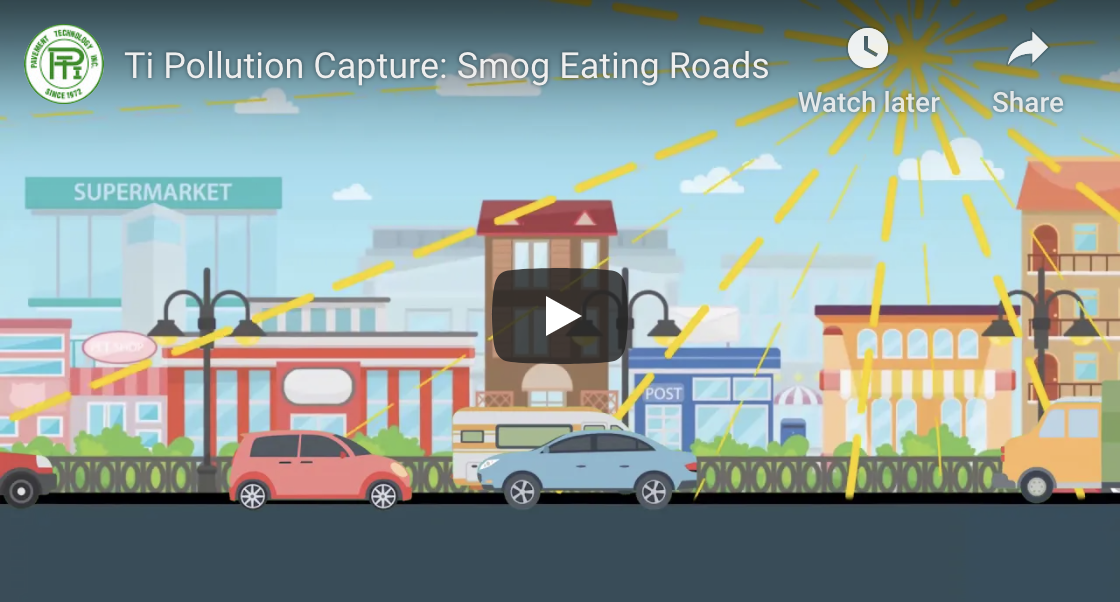
Photocatalysis can be thought of as a form of “artificial photosynthesis,” operating up to ten times faster and more efficiently than trees and plants at using sunlight to reduce heat and remove airborne contaminants.
While natural vegetation captures carbon dioxide (CO2), nitrogen oxides (NOx), and volatile organic compounds (VOCs), photocatalysis greatly accelerates and force-multiplies this natural air purification process to transportation infrastructure, which are the largest anthropogenic sources for problematic residual emissions.
Photocatalytic pavements incorporate engineered titanium dioxide (TiO2) nanoparticles into their upper surface layer. These nanoparticles absorb ultraviolet (UV) light while reflecting visible (VIS) and near-infrared (NIR) light, reducing heat absorption and creating a “cool pavement.” The UV energy is repurposed into chemical energy that generates natural oxidizers through the process known as photocatalysis. These oxidizers degrade pollutants– CO2, NOX, VOCs, and road-associated microplastics (RAMP)–at the surface by instantly mineralizing them for durable sequestration.
Applied to the high levels of CO2 present with vehicular traffic (400x to 1,000x ambient CO2 levels), it is a form of aggressive and high effective carbon dioxide removal (CDR).
The photochemical process is based on reduction by oxidation (redox). UV light triggers electron transfer, producing billions of reactive oxygen species (ROS)–tiny “micromotors” that attack pollutants. For example, ROS react with CO2 to form bicarbonates (HCO3–), effectively mineralizing and sequestering carbon for thousands of years.
OH– (ROS) + CO2 → HCO3– (bicarbonate)
PlusTi™ photocatalytic pavement upgrades have demonstrated the ability to capture and remove 30-50% of available CO2 at at least 400x ambient CO2 availability. Consequently, roadways, airways, and parking structures are prime environments for CDR. The combination of enhanced sequestration speed (10x that of natural photosynthesis) and elevated pollutant concentrations creates a powerful multiplier effect, enabling each lane-mile of photocatalytic pavement to permanently remove hundreds to thousands of metric tons of CO2 annually.
Just as trees convert short-cycle carbon dioxide into long-cycle carbon by harnessing sunlight for photosynthesis, photocatalytic pavements use sunlight to accelerate the process via photocatalysis. On a city planning scale, the cumulative environmental benefits are substantial. Research-backed and field tested modeling (MRV) indicates that one mile of photocatalytic roadway provides an equivalent air-purification and cooling effect comparable to the ecological services of 15-20 acres of established urban forest.
The concept of “synthetic forests” has been introduced in the literature to describe photocatalytic infrastructure as a surrogate for lost vegetative cover in highly urbanized environments.