Roadways & Airfields as Carbon Removal Factories
Photocatalysis can be thought of as a form of “artificial photosynthesis,” operating up to ten times faster and more efficiently than trees and plants at using sunlight to reduce heat and remove airborne contaminants.
While natural vegetation captures carbon dioxide (CO2), nitrogen oxides (NOx), and volatile organic compounds (VOCs), photocatalysis greatly accelerates and force-multiplies this natural air purification process to transportation infrastructure, which are the largest anthropogenic sources for problematic residual emissions.
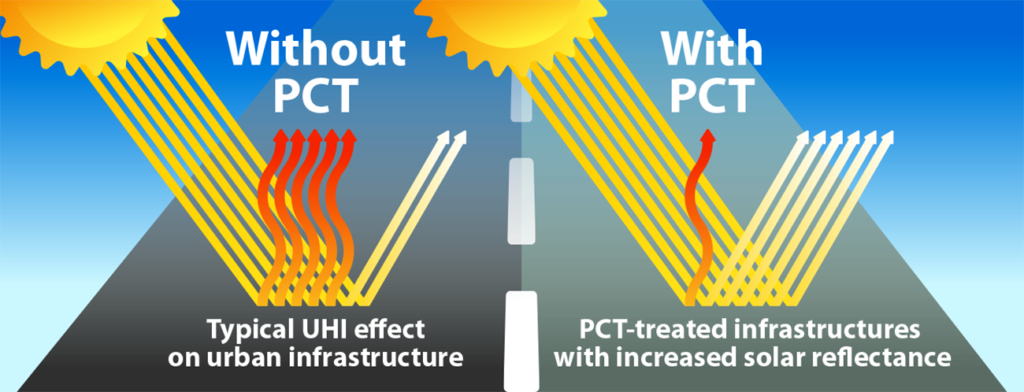
Photocatalytic pavements incorporate engineered titanium dioxide (TiO2) nanoparticles into their upper surface layer. These nanoparticles absorb ultraviolet (UV) light while reflecting visible (VIS) and near-infrared (NIR) light, reducing heat absorption and creating a “cool pavement.” The UV energy is repurposed into chemical energy that generates natural oxidizers through the process known as photocatalysis. These oxidizers degrade pollutants– CO2, NOX, VOCs, and road-associated microplastics (RAMP)–at the surface by instantly mineralizing them for durable sequestration.
Applied to the high levels of CO2 present with vehicular traffic (400x to 1,000x ambient CO2 levels), it is a form of aggressive and high effective carbon dioxide removal (CDR).
The photochemical process is based on reduction by oxidation (redox). UV light triggers electron transfer, producing billions of reactive oxygen species (ROS)–tiny “micromotors” that attack pollutants. For example, ROS react with CO2 to form bicarbonates (HCO3–), effectively mineralizing and sequestering carbon for thousands of years.
OH– (ROS) + CO2 → HCO3– (bicarbonate)
PlusTi™ photocatalytic pavement upgrades have demonstrated the ability to capture and remove 30-50% of available CO2 at at least 400x ambient CO2 availability. Consequently, roadways, airways, and parking structures are prime environments for CDR. The combination of enhanced sequestration speed (10x that of natural photosynthesis) and elevated pollutant concentrations creates a powerful multiplier effect, enabling each lane-mile of photocatalytic pavement to permanently remove hundreds to thousands of metric tons of CO2 annually.
Just as trees convert short-cycle carbon dioxide into long-cycle carbon by harnessing sunlight for photosynthesis, photocatalytic pavements use sunlight to accelerate the process via photocatalysis. On a city planning scale, the cumulative environmental benefits are substantial. Research-backed and field tested modeling (MRV) indicates that one mile of photocatalytic roadway provides an equivalent air-purification and cooling effect comparable to the ecological services of 15-20 acres of established urban forest.
The concept of “synthetic forests” has been introduced in the literature to describe photocatalytic infrastructure as a surrogate for lost vegetative cover in highly urbanized environments.
NEWS ALERT – City of Tucson Pilots Cool Pavement Program with University of Arizona
Category: PTI in the News By: admin
FOR RELEASE ON 2/21/2022
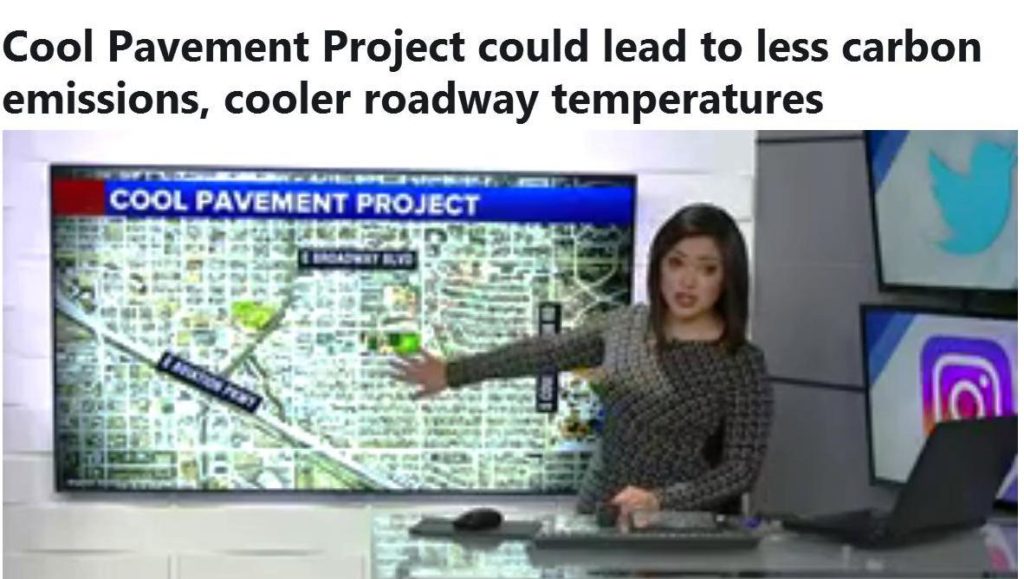
Westlake, OH – The City of Tucson, AZ recently partnered with the University of Arizona to evaluate the performance attributes of a new surface treatment for asphalt pavements designed specifically to reduce pavement emissivity (i.e., a surface’s ability to emit radiant heat), thereby mitigating the Urban Heat Island (UHI) effect that causes health concerns and rapidly deteriorates the quality of pavements.
The City of Tucson’s Department of Transportation and Mobility applied a PlusTi™ asphalt rejuvenation treatment developed by Westlake, Ohio-based Pavement Technology, Inc. (PTI) on a portion of Country Club Road in December 2021. The treatment deploys photocatalytic technology that reduces emissivity by tripling the solar reflectance value (SRI) of pavements. This new technology also meets the USGBC’s LEED and APWA/ISI ENV requirements for UHI reduction.
Tucson is a member of the Global Cool Cities Alliance (GCCA). This pilot project was developed in collaboration with the GCCA’s Cool Roadways Partnership, a consortium of jurisdictions, organizations and manufacturers committed to achieving scalable deployment of cool roadway options that foster heat-resilient communities.
Previous testing by the Texas A&M Transportation Institute at numerous pilot sites around the United States has demonstrated significant improvements in the SRI values of pavements treated with PlusTi™ technology. The University of Arizona will be conducting complementary testing related to human comfort factors, which are an adverse side effect of older albedo (aka “White asphalt”) products. Unlike albedo techniques, which cool pavement surfaces only, PlusTi™ roadway solutions embed into pavements UV-reflective TiO2 nanoparticles that are able to reduce emissivity and the air temperatures of surround areas at scale.
Michael Durante, PTI’s vice president of finance & strategic planning, explains: “Albedo products are very effective on roofs to lower BED (Building Electricity Demand), but are more problematic on pavements due to durability, aesthetics and human comfort concerns. In contrast, UV technology reflects thermal energy rather than absorbing it, targeting emissivity to capture a 24-hour cycle through which daytime energy is absorbed and then later remitted when night arrives.”
The results of the study are expected to be published later in 2022, and will be made available at PTI’s www.smogeatingroads.com website at that time. For more information, contact Chris Evers at cevers@pavetechinc.com or your local PTI technical representative, or visit the Global Cool Cities.